
European Roulette Online in the UK: Rules and Returns
 Available in GB
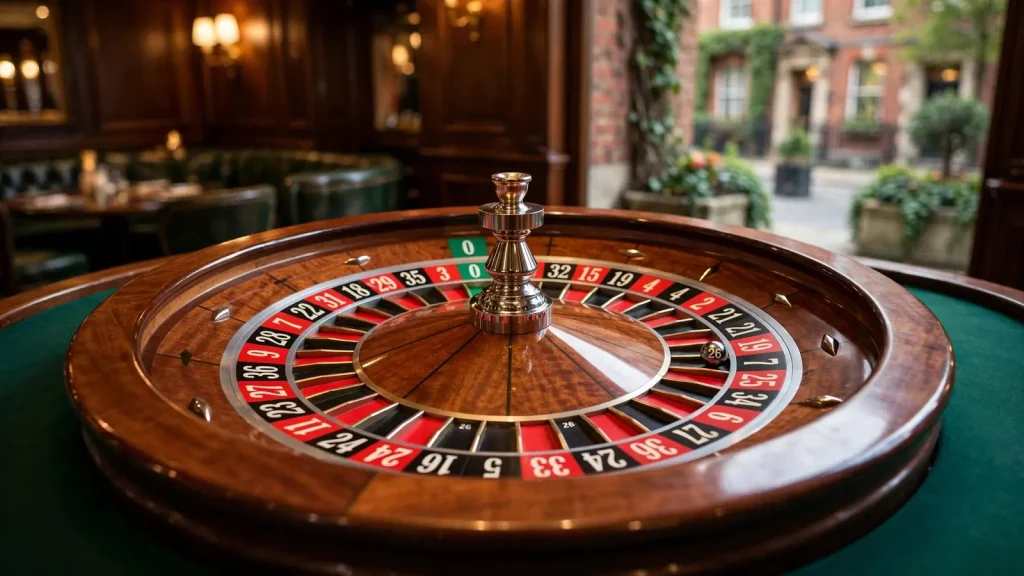
See how single-zero rules, payouts, table limits and game formats shape European roulette play.
Table of Contents
- European Roulette: 37 Pockets and a 2.70% House Edge
- Comparing Roulette Offers by the Terms That Affect the Return
- Roulette Bets, Payouts and the Limits of Betting Systems
- Roulette Tables, Wheels and Play Speeds
- Single-Zero Layouts and the Effect of Zero Rules
- Free Play, Real-Money Roulette and Account Limits
- Reading a European Roulette Table Layout
- Roulette-Branded Slots and Lightning Roulette Payouts
- Live Dealer Roulette: Physical Wheels and UK Safeguards
- European, American and French Roulette Compared
European Roulette: 37 Pockets and a 2.70% House Edge
European roulette is defined by a wheel with 37 pockets: one for each number from 1 to 36, plus a single zero. That structure determines the basic mathematics of the game. The zero is not an extra winning number attached to a particular colour or number range; it is a separate outcome that affects the return across wagers. The wheel’s layout may be shown on screen or represented by a physical wheel in a streamed game, but the underlying count remains the same.
The house edge is 2.70%. It describes the casino’s theoretical advantage over time under the game’s standard rules, rather than a fee deducted from each stake or a forecast for an individual session. In practical terms, the figure expresses the expected proportion of money wagered that is not returned to players over a sufficiently large number of spins. A short run can end above or below that expectation. The percentage is a long-run measure, not a promise about what happens next.
When choosing a UK online casino for European roulette in 2026, payout information is one practical detail to consider. These verdicts stick to the information available for each operator.
1. SpinFormula
Payout speed: 1-3 business days SpinFormula lists a payout speed of 1–3 business days.
2. NightWin
Payout speed: 1-3 business days NightWin lists a payout speed of 1–3 business days.
3. Revery Play
Payout speed: 1-3 business days Revery Play lists a payout speed of 1–3 business days.
4. BeOnBet
Payout speed: 1-3 business days BeOnBet lists a payout speed of 1–3 business days.
5. Dieselwin
Payout speed: 1-3 business days Dieselwin lists a payout speed of 1–3 business days.
6. WinBeast
Payout speed: 1-3 business days WinBeast lists a payout speed of 1–3 business days.
7. Britsino
Payout speed: 1-3 business days Britsino lists a payout speed of 1–3 business days.
8. x3bet
Payout speed: 1-3 business days x3bet lists a payout speed of 1–3 business days.
9. Amunbet
Payout speed: 1-3 business days Amunbet lists a payout speed of 1–3 business days.
10. EvoSpin
Payout speed: 1-3 business days EvoSpin lists a payout speed of 1–3 business days.
The calculation depends on the relationship between the number of possible outcomes and the game’s payouts. On a standard European wheel, the extra zero outcome creates the house advantage. A wager can still win on a particular spin, and a series of wins can occur, but the overall return is shaped by the rules applied across all possible outcomes. The stated edge captures that balance in one figure. It is therefore more useful for comparing the basic cost of a game than the appearance of its interface or the pace at which spins are offered.
For someone assessing an online European roulette casino in the UK, the wheel structure is the starting point for understanding what is being played. The label “European roulette” refers to the single-zero format, not to a special guarantee of a particular result. A game presented under that name should be read in terms of its rules and stated return conditions, rather than treated as a different mathematical proposition because it appears in a casino lobby, a browser window or an app. The central calculation remains tied to the 37-pocket wheel.
The house edge also needs to be distinguished from the probability of an individual result. It does not mean that a casino takes 2.70% from every wager as soon as it is placed. Nor does it mean that a player will lose precisely that share during a particular visit. Outcomes are determined by chance, and an individual sequence can vary considerably from the long-run expectation. The percentage describes the average relationship between stakes and returns when the game is considered over time, not a schedule of losses for each player.
Real Money Slots and Table Games: Bounty Reels UK Catalogue · 5-Reel Slots in the UK: How Bets and Reels Work
That distinction matters when casino descriptions use broad claims about “fairness” or a favourable experience. The pocket count and house edge are concrete features; atmosphere, graphics and presentation do not alter them. If two games use the same standard European rules, the relevant baseline is the same wheel structure and the same theoretical edge. Any claim that a particular version changes the underlying calculation would need to be supported by a specific rule difference, not by a different theme or a polished display.
The zero is the structural reason European roulette is not an even contest between player and casino. Although the numbered pockets give the wheel its familiar range, the additional green pocket affects the mathematical balance. Without considering that outcome, a description of the game would omit the feature that explains the edge. The single zero is therefore not a minor visual detail; it is part of the calculation used to assess the standard game.
A 2.70% house edge is a relatively compact summary, but it should be interpreted carefully. It does not rank a casino, indicate how quickly a balance will change, or show whether a particular spin is more likely to win. It describes the game’s built-in theoretical cost under standard European roulette rules. The result of any one spin remains uncertain, and no strategy can turn the edge into a prediction of the next outcome.
The useful baseline is consequently precise: 37 pockets, including one zero, and a theoretical house advantage of 2.70%. Those two details explain the core mathematics of European roulette before any separate consideration of wagering conditions, table formats or special rules. For an online casino offering European roulette, the name alone is not the calculation; the defining single-zero structure is.
Wheel structure 37 pockets (1-36 plus a single zero)
House edge 2.70%
Defining feature Single-zero format
Comparing Roulette Offers by the Terms That Affect the Return
A roulette offer is not defined by its headline bonus. Its value depends on the game’s stated return information, how roulette wagers count towards the wagering requirement, and whether the terms distinguish between live and RNG games. Those conditions determine how much play is needed before bonus funds can be withdrawn, if the offer permits withdrawal at all.
RTP is the game’s published theoretical return over a large number of plays, not a forecast for an individual session. For UKGC-licensed operators, the relevant figure should be accessible in the game information or rules. It gives a basis for comparing the listed game versions, but it does not alter the bonus conditions or guarantee a particular result. If the RTP information is hard to locate, the offer cannot be assessed fully from its headline terms.
Read game weighting before valuing the bonus
Bonus funds are subject to conditions. One of the material terms is game weighting: the share of each qualifying wager that counts towards the wagering requirement. A roulette bet may count for less than its cash value, so a large-looking bonus can require substantially more play than the headline suggests.
Across UK operators, roulette wagers are commonly credited at a rate between 10% and 20% towards wagering requirements. The rate is operator-specific, however, and should be checked in the offer’s eligible-games list and full terms. A contribution rate is not a payout rate: it measures progress against the wagering condition, not the return from the roulette game.
Online Casino Tournaments UK: Entry and Prize Terms
The distinction between live and RNG roulette can change the calculation. One specialist review reports that live roulette may receive 10% or 20% game weighting, while RNG roulette can be credited in full. Those figures should not be treated as a universal schedule. The operator’s own terms for the specific promotion and game take precedence. Where live roulette is excluded, its wagers do not advance the requirement; where it is included at a reduced rate, only that stated share counts.
This makes a direct comparison more useful than a list of supposed best European roulette casinos. For each offer, note the bonus amount, the wagering requirement, the eligible roulette format and its game weighting. Then calculate the credited wagering from the amount actually staked. A high bonus with low roulette weighting may be less useful for roulette play than a smaller offer with clearer, more favourable terms. The arithmetic is less decorative than the headline, but more relevant.
Check the cap and the operator’s status
A specialist review reports that, from January 2026, UK rules cap bonus wagering at a maximum of 10 times for licensed operators. That reported cap does not remove the need to read the promotion itself: eligibility, game weighting and any other withdrawal conditions still affect the amount of qualifying play. The UK Gambling Commission (UKGC) is the sole regulator of online casino activity in Great Britain, and its framework applies to operators serving that market.
The practical comparison is therefore between the published game information and the complete offer terms, not between promotional labels. RTP describes a game’s theoretical return; game weighting determines how roulette play is treated against bonus conditions. Neither should be substituted for the other. A claim that an offer is the best online casino for European roulette has little analytical value unless those terms are visible and comparable.
Do
- Check the specific game weighting for roulette
- Verify the operator’s UKGC license status
- Compare the published RTP with bonus terms
Don’t
- Rely solely on the headline bonus amount
- Assume a high bonus means favorable terms
- Substitute RTP for game weighting
European roulette rules govern the game itself; bonus rules govern whether a wager counts towards an offer. Keeping those two sets of conditions separate prevents a misleading comparison. An operator may provide the same roulette game as another while applying different wagering treatment. The decisive details are the stated RTP for the game version and the promotion’s specific weighting for that game.
Roulette Bets, Payouts and the Limits of Betting Systems
A roulette wager is defined by the outcome it covers. A bet on one number has a larger quoted payout than a bet covering a group of outcomes, but it is less likely to win. The payout table sets the return for a winning selection; it does not alter the chance of the next spin or make a losing selection due to be returned.
For a straight-up bet, the stake is placed on a single number. On European roulette, that selection pays 35:1 if it wins. The same quoted payout applies to a straight-up bet on American roulette. This is the highest standard payout among the examples below, but it also covers just one number.
Inside bets cover compact groups of numbers. A split bet covers two adjacent numbers and pays 17:1. A street bet covers a horizontal row of three numbers and pays 11:1. These bets trade some of the straight-up payout for coverage of more outcomes. Their names and payouts describe the selection, not a method for improving the likelihood of future spins.
Outside bets cover broader categories. Red or black, even or odd, and high or low each pay 1:1. The smaller payout reflects the wider selection. These bets may appear less volatile than a single-number wager because they cover more outcomes, but no betting category changes the fact that each result is determined by chance.
Online Casino Without ID in the UK: How Checks Work
A player learning how to play European roulette can begin by comparing the selection on the table with its stated payout. The main distinction is straightforward: inside bets target smaller groups and carry higher quoted returns, while outside bets cover broader categories and pay less. The payout applies only when the chosen selection wins. A losing wager is not protected by choosing a different category on the next spin.
The Martingale system changes stake size rather than the underlying bet. Its rule is to double the stake after each loss, on the assumption that a later win can recover earlier losses. That assumption creates a cash-flow problem: each loss increases the next required stake, while a losing streak can substantially damage a bankroll. A win may recover losses accumulated in the sequence, but it does not erase the possibility of another loss or make the next result more likely to favour the player.
No staking system can predict the final outcome of a roulette spin. Roulette odds are determined by chance, so repeating a bet, changing its size or switching from inside to outside selections does not provide information about what comes next. The Martingale is therefore a method of managing stakes, not a forecasting tool. Its arithmetic is certain; the event it depends on is not.
The same distinction matters whether European roulette is played online for money or in a free-play mode. A displayed payout describes the game’s rules, while a staking plan describes how someone chooses to place wagers. Neither changes the chance-based result. “VIP” table labels do not, by themselves, establish different bet payouts: the relevant terms are the table’s stated selections and returns.
Straight-up bet
Placed on a single number; pays 35:1.
Inside bets
Covers small groups, such as split (17:1) or street (11:1) bets.
Outside bets
Covers broad categories like red/black or even/odd; pays 1:1.
Roulette Tables, Wheels and Play Speeds
A European roulette game can be presented in several formats, and the format affects how quickly rounds proceed and what stake is accepted. The same European wheel rules may sit behind different interfaces: a random-number-generator game, an automated table or a live table. The choice is operational rather than a change to the game’s underlying roulette bets.
RNG tables
RNG roulette uses software to generate each result instead of a physical wheel. That removes the time taken by a dealer to manage a round, so play can move more quickly. The minimum stake may also be lower: RNG tables can be available from 10p, although the amount depends on the particular game and operator.
This format suits a player who wants to set a stake, place bets and move through rounds without waiting for a live table to complete its cycle. The speed is also a budgeting consideration. A smaller stake does not by itself control the total spent if rounds are happening more quickly; the number of decisions made in a session matters as well.
Auto-roulette and speed play
Auto-roulette and speed roulette are labels for formats designed to shorten the time between rounds. They should not be treated as synonyms for RNG: a table’s name and presentation do not, on their own, establish how its results are generated. The game information identifies the format and its rules.
Online Bingo in the UK: Games, Bonuses and Slots
A specialist review reports standard roulette tables at 80–100 spins per hour and speed roulette at more than 150. Those figures describe the pace cited for the formats, not a guaranteed rate for every table. Actual play can vary with the interface and the time allowed for betting. Faster rounds mean less time between decisions, not improved odds.
The same review source puts the minimum for some auto-roulette and speed tables at 5p. That is a possible entry stake, not a market-wide promise. The table’s displayed minimum is the relevant figure when comparing games.
Live tables and the practical comparison
A specialist review also reports live roulette minimum stakes beginning at 10p. A live table’s pace is tied to its round cycle, while RNG and automated formats can move through results without the same pauses. That makes a direct comparison more useful than assuming that all games bearing the European roulette name operate at one speed.
For a European roulette casino wheel, the format label is only one part of the decision. The stake floor determines how small a single bet can be; the pace determines how often another betting decision arrives. A low minimum can make individual bets smaller, but it does not set a session budget or slow a rapid game. Conversely, a standard table’s slower cycle does not change the stated minimum stake.
The interface should also make the selected game and its table rules clear before play begins. A European roulette wheel has the same game identity whether presented through RNG software or an automated format, but the operating experience differs. Comparing the stated minimum and the indicated pace gives a more concrete basis for choosing than relying on a format name alone.
Table Formats
- RNG tables offer faster play and potentially lower minimum stakes from 10p.
- Auto and speed roulette shorten the time between rounds.
- Live tables follow a round cycle tied to a physical wheel and dealer.
- Format choice affects pace and entry stakes, not the underlying odds.
Single-Zero Layouts and the Effect of Zero Rules
A European roulette wheel has a single green pocket marked zero, alongside the numbered pockets from 1 to 36. On the table layout, the zero sits apart from the main numbered grid. That separation matters: a wager on a numbered position and an even-money wager are treated differently when the ball stops there.
Without a special rule, zero is not red or black, odd or even, high or low. Those outside bets cover the numbered outcomes indicated by their labels, so a zero result does not match them. The same distinction applies to inside bets placed on particular numbers or groups of numbers: zero is its own pocket, not part of the numbered selections. The layout therefore shows more than where chips can be placed; it marks a result that can affect different wagers in different ways.
What single zero means for a wager
The single-zero designation describes the wheel’s green pocket, not a separate bet type. It is one outcome among 37 pockets, and it remains relevant even when the rest of the table appears to offer straightforward choices such as red or black. A single-zero wheel does not make every wager behave alike. The selection on the layout determines whether zero counts as a win, a loss or a result covered by a table rule.
La Partage changes the outcome for even-money bets when the ball lands on zero. Instead of losing the whole stake, the player receives half of it back. The remaining half is lost. This applies to the even-money categories covered by the rule; it does not turn zero into red, black, odd, even, high or low, and it does not change the number selected by an inside bet.
Live Dream Catcher Casino UK: What to Know
That refund changes the cost of an even-money wager over repeated play. With La Partage, the house edge on those bets is 1.35%. The figure applies to the qualifying even-money bets under the rule, not automatically to every betting option on the table. A number wager remains a number wager, and the refund provision described here does not apply to it.
Reading the rule before placing chips
A single-zero table layout can show where the pocket is, but the layout alone does not establish whether La Partage applies. The rule needs to be stated for the table. Where it is offered, the practical difference appears only when zero lands and an even-money bet is in play: half the stake is returned rather than the full stake being lost. On other outcomes, that particular zero provision has no effect.
This makes the table’s zero rule part of the price of an even-money bet. The green pocket remains a losing result for those bets without a refund provision; with La Partage, only part of the stake is lost on zero. The reduced 1.35% house edge belongs specifically to that arrangement. Treating it as the edge for every wager on a European roulette table would misstate the terms.
Free Play, Real-Money Roulette and Account Limits
A European roulette demo lets a player try a table without staking cash. Where a casino offers this mode, the balance is for practice rather than withdrawal: it does not represent money deposited or winnings available to cash out. The format can help familiarise a player with the controls, but it does not change the terms or chance involved when real funds are used.
Licensing Risk
Real-money roulette in Britain must only be played via operators holding a current UK Gambling Commission (UKGC) licence to be legal.
A roulette table demo is also different from a roulette-branded slot demo. The first simulates a roulette game; the second refers to a slot product with roulette in its theme or title. A slot’s reels and payout rules are not the same as a conventional roulette wheel, so the word “roulette” alone does not identify the game mechanics.
Real-money roulette in Britain is available only through operators holding a current UK Gambling Commission licence. Remote operators serving the British market must hold the relevant licence, regardless of where they are based. A platform without a valid UKGC licence cannot legally offer real-money play to British residents. The licence should be checked on the Commission’s public register before an account is funded; a familiar brand name or a polished cashier is not a substitute for regulatory status.
Age and account controls apply before play. Operators must verify a customer’s age before allowing a deposit into a gambling account. Online gambling is legal for people aged 18 and over when the operator holds a UKGC licence. New customers must also be prompted to set a financial limit before their first deposit, and account-level limit controls must remain accessible. These are operating requirements, not optional features hidden in a promotions page.
Payment eligibility is narrower than the list of buttons in a cashier may suggest. UKGC-licensed casinos cannot accept credit cards for gambling. The restriction also covers credit-card funds routed through a money service business, and operators cannot accept wallet payments if that wallet permits credit-card funds to be used for gambling. A payment method’s presence on screen therefore does not establish that every funding source behind it is permitted.
Chicken Road Game in UK Casinos: What to Check
For a real-money session, the relevant comparison is between the cash deposited, the account limits in force and the game’s stated terms. RNG roulette simulates spins using a random number generator; it can offer faster play and lower minimum stakes, with some games starting at 10p. That describes a possible entry stake, not a recommended budget or a measure of risk. A demo removes the deposit decision; it does not make a real-money session equivalent.
Reading a European Roulette Table Layout
A European roulette table has two linked parts: a numbered betting grid and a set of outside betting areas. The grid represents the numbered pockets on the wheel; the separate zero space represents its single green pocket. The layout is a map for placing bets, not a prediction of where the ball will land.
The numbered grid is arranged in horizontal rows of three, with the numbers running from 1 to 36. Each number has its own small betting space. A chip placed fully inside one of those spaces selects that number alone. Chips placed across the boundary between two neighbouring numbers select both, creating a split bet. The printed grid determines which numbers share a boundary; the wheel’s physical order is not what defines an adjacent pair for this bet.
A street bet covers a complete horizontal row of three numbers. Its chip sits at the row’s outer edge rather than on one number or between a pair. A street pays 11:1 if any of its three numbers wins. A split bet on two adjacent numbers pays 17:1. These labels describe the return on a winning wager, not the total amount returned.
Outside the numbered grid, the table marks broader groups. Red and black cover the coloured numbers; even and odd divide them by parity; high and low cover the lower and upper ranges. A winning red/black, even/odd or high/low bet pays 1:1. The zero is not red or black, even or odd, or part of either high/low group, so it does not belong to those outside categories.
The zero pocket is separate from the main numbered grid and does not count as red or black, odd or even, high or low.
This distinction helps identify what a chip actually covers. A chip on a single number is not the same wager as one touching a dividing line, and a chip at the end of a row can cover three numbers rather than one. On a European roulette casino table, the printed boundaries and labels are the operative guide: placement determines the selection.
A useful way to read a European roulette table layout is to trace each bet from the chip position to the marked numbers or group. The grid handles specific numbers and combinations; the outer boxes handle categories. The single zero has its own space, rather than being folded into the numbered rows or an even-money group.
The layout can make bet selection legible, but it does not create a European roulette strategy that changes the result of a spin. It only shows which outcomes a wager covers and the stated payout category attached to it.
Roulette-Branded Slots and Lightning Roulette Payouts
A title that combines “roulette” with words such as “gold”, “platinum” or “3D” does not, by itself, identify a conventional roulette table. Roulette-branded slots are a separate product category: the theme may borrow the wheel, colours or terminology, but the name alone does not establish the game’s rules or odds. A slot’s return information and paytable need to be read as those of that specific slot, rather than inferred from a European roulette table.
That distinction matters when comparing roulette odds. On a conventional European wheel, a straight-up bet has a fixed payout of 35:1. A slot that uses roulette imagery does not inherit that payout simply because its title sounds like a table game. Its symbols, winning combinations and any stated return belong to the slot’s own rules.
Keno Casinos in the UK: Rules, Odds and Payouts
Lightning Roulette is a roulette game, but a specialist review reports a different straight-up payout when no lightning multiplier applies: 29:1 rather than the standard 35:1. The same specialist review reports that outside bets retain standard roulette payouts. These are terms specific to the described Lightning Roulette format; they should not be assumed to apply to every roulette-branded product or every game carrying a similar name.
The comparison changes the return attached to an individual winning number bet. A familiar roulette layout is not enough to establish that the payout matches a standard table, so the displayed rules and paytable are material. Lightning multipliers are a separate feature; the 29:1 figure concerns a straight-up win without one and should not be read as the payout where a multiplier applies.
For slot searches, names such as Book of Dead illustrate why product type needs checking: a recognisable casino-game title is not evidence that the game follows roulette rules. Roulette-themed artwork is packaging, not a substitute for the paytable. In Britain, online slots also have rules that do not describe roulette tables: autoplay is banned, and each slot spin must last at least 2.5 seconds.
A practical comparison therefore separates three things: a conventional roulette table’s stated payout, the rules of a roulette-themed slot, and any special payout feature within a named roulette game. Treating them as interchangeable can make a displayed odds figure look comparable when it is not. The game’s own rules determine which bet or feature the figure describes.
Payout Differences
Attention Not all roulette-branded games share the same payouts; for example, Lightning Roulette may pay 29:1 for straight-up wins without a multiplier.
Live Dealer Roulette: Physical Wheels and UK Safeguards
A live European roulette table uses a real wheel in a studio, with a human dealer releasing the ball and managing each round. The stream shows the physical event rather than a result generated by a random number generator. The dealer’s presence changes the format, not the need to understand the table’s terms or the operator’s regulatory status.
For real-money play offered to customers in Great Britain, the operator must hold the relevant UK Gambling Commission (UKGC) licence. The UKGC is the sole regulator of online casino activity in Great Britain. A platform without a valid UKGC licence cannot legally offer real-money live roulette to British residents, even if its broadcast is accessible. The operator’s location does not remove the licensing requirement.
Before depositing, the licence can be checked against the UKGC public register. A compliant operator must verify a customer’s age before allowing a deposit into a gambling account. It must also prompt new customers to set a financial limit before their first deposit and provide accessible account-level controls for adjusting limits.
Mines Casino Game UK: Rules, Play and Offers
The safeguards apply beyond the deposit stage. UKGC-licensed live casino operators must offer deposit and loss limits, session-time reminders, reality checks, cool-off periods and GamStop self-exclusion. These are separate controls: a deposit limit governs money paid into the account, while a loss limit and session prompts address what happens during play. A cool-off period restricts access temporarily; GamStop is the self-exclusion option.
There is also a formal route for disputes. UKGC licensees must provide an internal complaints process and access to an approved Alternative Dispute Resolution service if the complaint remains unresolved. Operators are required to contribute to the Research, Education and Treatment levy, which funds gambling-harm research, education and treatment.
A streamed wheel is not, by itself, evidence that a table is operating under British rules. The relevant checks concern the company accepting the stake: its UKGC licence, its account controls and the protections available when play needs to stop. If those conditions are absent, the studio presentation does not supply them.
Progressive Jackpot Slots: How Pools Work
European, American and French Roulette Compared
The central difference between European and American roulette is the number of pockets competing with a winning number. A European wheel has numbers 1 to 36 plus one zero, making 37 pockets. An American wheel adds a double zero, for 38. That extra pocket changes the expected return even though the numbered bets retain the same stated payout.
On a standard European table, the house edge is 2.70%. On American roulette it is 5.26%. The difference comes from the additional losing outcome: the double zero gives the house another pocket on which ordinary number bets lose. For someone comparing an online European roulette game with an American table, the wheel’s pocket count is therefore a more useful starting point than the visual design or dealer format.
American roulette also has a basket bet covering the zero, double zero, and the first numbers. Its house edge is 7.89%, higher than the standard American game’s edge. The bet’s name can sound like a convenient way to cover several outcomes; mathematically, it is a more costly choice.
3-Reel Slots in the UK: Formats and Play
A small number of American tables may add a third green pocket marked 000. One specialist review describes such a layout and gives it a 7.69% house edge. That figure should be treated as specific to the reported table format, not as a general feature of American roulette. The extra pocket changes the calculation again, so the displayed rules matter.
French roulette is associated with the lowest house edge among standard variants because of La Partage and En Prison. Those rules affect what happens to even-money bets when the ball lands on zero; they do not make the outcome predictable. The advantage is conditional on the table applying the relevant rule, so the rule panel is part of the price comparison.
In practical terms, European roulette offers a lower standard edge than American roulette, while French rules can reduce it further for qualifying bets. The label alone is not enough: pocket count and the treatment of zero determine the terms.
What is the house edge on European roulette compared to American roulette?
European roulette has a 2.70% house edge, compared with 5.26% on standard American roulette. Some American tables with a 000 pocket have a 7.69% edge.
What are inside and outside roulette wagers?
Inside wagers cover specific numbers or small groups of numbers, such as a straight-up bet or a split bet. Outside wagers cover broader groups, such as red or black, even or odd, and high or low.
Should I play American or European roulette if I’m in the UK?
European roulette has the lower house edge: 2.70%, compared with 5.26% for standard American roulette. On the house-edge figures alone, European roulette is the lower-cost option over the long run.
What is the difference between European and American roulette wheels?
A European wheel has 37 pockets: numbers 1 to 36 and one zero. An American wheel has 38 pockets, adding a double zero; some tables also include a 000 pocket.

Real Dealer Games: Bounty Reels UK Live Casino 2026
Bounty Reels UK Guide UK live casino information Bounty Reels includes a live casino category,...

Aviator Casino Game in the UK: Regulation and Play
A guide to UK regulation, crash-game mechanics, bonus terms and the limits of claims about...

3-Reel Slots in the UK: Formats and Play
A guide to three-reel layouts, free play, game features and the role of the casino...

5-Reel Slots in the UK: How Bets and Reels Work
See how five-reel layouts, qualifying patterns, demo play and real-money stakes shape a slot session....

Bonus Buy Slots in the UK: Demos and Real-Play Costs
Explore bonus-buy controls, simulated features and the factors that affect the cost and feel of...

Online Keno Payouts: Paytables, Odds and Draws
Keno outcomes depend on the numbers selected, the random draw and the game's paytable—not on...

UK First-Deposit Casino Bonuses: Terms Explained
A framework for assessing eligibility, qualifying deposits, activation steps and the restrictions that shape a...

High-Volatility Slots UK: How Their Risks Differ
High volatility affects how wins are distributed over time, while reel layout, bet settings and...

Keno Casinos in the UK: Rules, Odds and Payouts
Learn how picks and draws work, why past results offer no edge, and which paytable...

Live Casino UK: How Online Live Play Works
Live casino play pairs a real-time dealer broadcast with software that records bets and displays...

Low-Volatility Slots in the UK: How They Work
Low volatility usually means smaller wins occur more often, but it does not guarantee a...

Online Slot Payout Percentages: What RTP Means
A payout percentage compares stakes with theoretical prizes over play, not the amount a player...

Progressive Jackpot Slots: How Pools Work
Progressive slots direct part of wagers into growing prize pools, while eligibility and payout terms...

Best RTP Casino Slots UK: Understanding Slot Returns
See how theoretical return, volatility and game information shape comparisons between online slots without treating...

High-RTP Slots in the UK: What RTP Can Tell You
RTP is a theoretical long-run measure, so published figures cannot predict a session or an...

Best Video Slots in the UK: How They Work
A practical guide to slot mechanics, free play, licensed sites, mobile sessions and the costs...

Casino dice games in the UK: odds and play
A guide to random outcomes, house advantage, demo play and the differences between UK and...

Chicken Road Game in UK Casinos: What to Check
A practical guide to distinguishing a game description from confirmed details about its mechanics, availability,...

Classic Slots Online in the UK: How They Work
A practical guide to classic slot layouts, demo play, machine features and the checks involved...

Crash Casino Games in the UK: Format and Access
Crash games are a format label; availability, regulation and payment options depend on the specific...

Crazy Time Live Casino Game Show in the UK
Crazy Time pairs real-time studio footage with an online betting interface, while casino terms and...
Deal or No Deal Casino UK: Slot Features Explained
The slot begins with a three-ring qualification condition, followed by an optional Top Up and...

Live Dream Catcher Casino UK: What to Know
The guide distinguishes studio-streamed dealer play from computerised games and explains what to check when...

Fastest payout online casinos in the UK: how to compare
A useful comparison defines the event being timed, its start and end points, and the...

French Roulette Online Casino UK: Rules and Odds
A practical guide to zero outcomes, payouts, table limits and the differences between French, European...

Fruit Machine Slots in the UK: How Online Play Works
A practical guide to digital reels, game features, demo play and the limits that shape...

Hi-Lo Casino UK: Rules, Odds and Game Types
Hi-Lo compares the next draw with an exposed card, while rules for ties, collecting and...

JetX Casino Game in the UK: What the Label Means
A clear look at how the slot label is used and why it cannot establish...

Live Casino Lightning Roulette in the UK
A practical guide to live feeds, roulette bets, table checks and the limits of demo...

Live Baccarat Online Casinos in the UK: How Play Works
Live baccarat pairs a dealer conducting the game in a studio with an online system...

Live Blackjack Online Casinos in the UK: Rules and Play
The guide links blackjack’s 21-or-less objective with live-table rules, casino terms, formats and practical play...

Live Roulette UK with English-Speaking Dealers
The format changes how results are produced and presented, while both games compare a number...
Mines Casino Game UK: Rules, Play and Offers
A practical guide to checking game rules, demo access, bonus terms and operator licensing without...

Monopoly Live casino in the UK: how it works
A practical guide to how live dealer broadcasts and betting controls work, with attention to...

Online Bingo in the UK: Games, Bonuses and Slots
Bingo is built around tickets, draws and patterns, while casino games have separate rules and...

Online American Roulette in the UK: Odds and Rules
Learn how the extra pocket affects roulette odds and how game format, betting terms and...

Online Casino Games for Real Cash in the UK
A stake is committed before a game produces its result, while offer conditions and payment...

Online Casino Tournaments UK: Entry and Prize Terms
Tournament formats, scoring rules and prize terms differ, so check the conditions for the named...

Online Casino Without ID in the UK: How Checks Work
The guide distinguishes document-free signup language from a promise of never being checked, within UK...

Penny Slot Machines in the UK: Stakes and Play
Penny slots are classified by their lowest total spin cost, with guidance on demos, returns,...

Plinko Casino UK: Licensing, Offers and Payments
The guide examines licensing, promotional value, random outcomes and payment conditions rather than ranking casino...

Progressive Slots Online in the UK: Jackpot Guide
See how linked wagers fund jackpot pools and how those contributions relate to a slot’s...

UK Gambling Casino Sites for Slots: What to Check
A practical look at licensing, slot mechanics, withdrawals, bonuses and player controls on UK gambling...






























































































































































































































































