
Online Casino Payment Methods in the UK: A Guide
 Available in GB
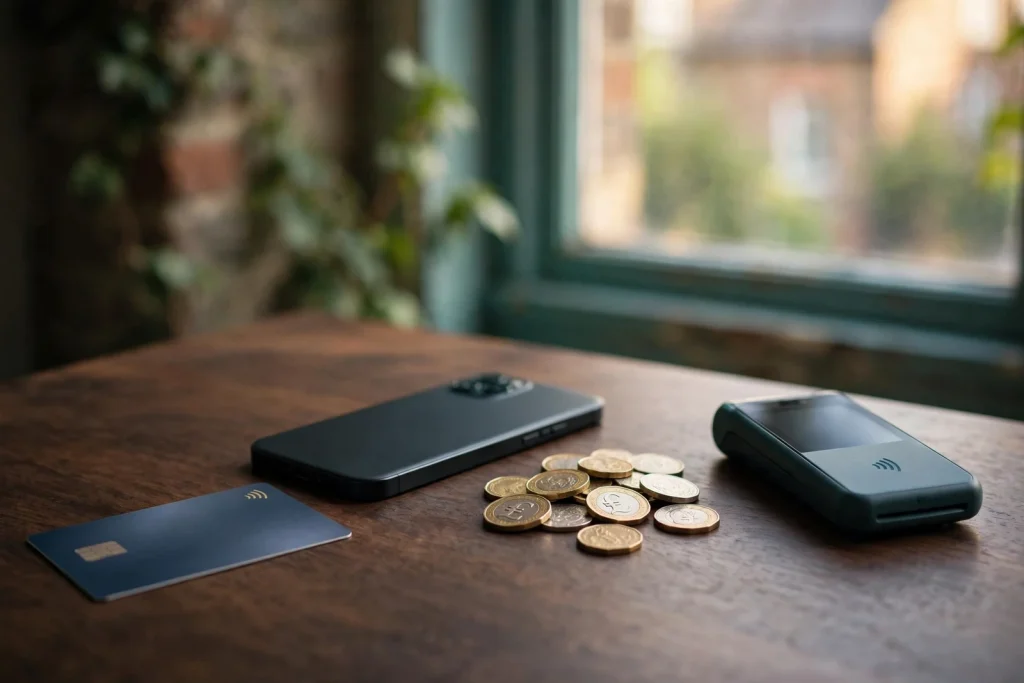
The guide distinguishes mobile access from phone-bill payments and explains how bank-linked services, wallets and other options work.
Table of Contents
- Paying by Phone: Where Mobile Fits
- SMS and Paysafecard: Payments Without Sharing Card Details
- Casino Payment Methods: The Practical Trade-Offs
- Apple Pay and Google Pay at UK Casinos
- Payment Options, Limits and Account Controls
- Trustly and Bank-Linked Casino Payments
- Neteller and E-Wallet Payments
- PayPal at Online Casinos
- Boku and Phone-Bill Payments
- Fast and Safe Payments: What Can Be Verified
Paying by Phone: Where Mobile Fits
A phone is a way to reach a casino account, not a deposit method in its own right. The distinction matters because “paying by phone” can describe two different things: using a mobile device to make a deposit through an available option, or charging a payment to a phone bill. Those routes have different mechanics. A mobile screen alone does not identify which one is involved.
For an online casino mobile payment, the device is the point of access. A customer may open the casino’s mobile website or an app, sign in, select a deposit method offered by that operator and complete the transaction through the relevant service. The phone is involved in the interaction, but the underlying payment may be bank-linked, wallet-based or another supported route. The method remains the method, even when the transaction starts on a handset.
That distinction prevents a common category error. Apple Pay is a wallet option; Trustly is a bank-linked service; Boku is associated with phone-bill payment. None is another name for mobile access. A casino can be usable on a phone without offering any particular one of those services, and an individual service may be available through more than one type of device. Availability depends on the operator’s supported deposit methods and the conditions attached to them, not on the fact that the account is being viewed on a phone.
Choosing a casino payment method involves considering how long withdrawals take, as well as which options suit your needs. This list highlights the payout-speed information available for each operator.
1. SpinFormula
Payout speed: 1-3 business days SpinFormula lists a payout speed of 1–3 business days, a useful detail to consider when reviewing payment options.
2. NightWin
Payout speed: 1-3 business days NightWin lists a payout speed of 1–3 business days, giving readers a stated timeframe to consider.
3. Revery Play
Payout speed: 1-3 business days Revery Play lists a payout speed of 1–3 business days. This gives a clear reference point when considering its payment arrangements.
4. BeOnBet
Payout speed: 1-3 business days BeOnBet lists a payout speed of 1–3 business days, which is the available detail about its payment timing.
5. Dieselwin
Payout speed: 1-3 business days Dieselwin lists a payout speed of 1–3 business days, providing a stated timeframe for withdrawals.
6. WinBeast
Payout speed: 1-3 business days WinBeast lists a payout speed of 1–3 business days. Readers can use this timeframe when weighing payment options.
7. Britsino
Payout speed: 1-3 business days Britsino lists a payout speed of 1–3 business days, offering a concrete detail on payment timing.
8. x3bet
Payout speed: 1-3 business days x3bet lists a payout speed of 1–3 business days. This is the stated information available about its payout timing.
9. Amunbet
Payout speed: 1-3 business days Amunbet lists a payout speed of 1–3 business days, giving readers a timeframe to keep in mind.
10. EvoSpin
Payout speed: 1-3 business days EvoSpin lists a payout speed of 1–3 business days, providing a stated reference point for withdrawal timing.
The word “mobile” therefore says little about where the money comes from. A deposit made on a phone does not become a phone-bill charge simply because the device is a phone. Nor does a payment become a mobile wallet transaction merely because it passes through a mobile interface. The relevant detail is the source and route shown when the deposit is selected and confirmed. If that information is unclear, the transaction should not be treated as understood just because the screen labels the experience as mobile.
A mobile casino payment also remains subject to the same UK requirements as a deposit made another way. Operators must verify a customer’s age before allowing funds to be deposited into a gambling account. The small size of a screen, the speed of a checkout flow or the use of an app does not change that obligation. A deposit should not be accepted before the required age check has taken place.
The rules on funding apply too. UK-licensed casinos cannot accept credit-card payments for gambling, including credit-card funding routed through a money service business. They also cannot accept wallet payments where the wallet allows credit-card funds to be used for gambling. Moving the transaction onto a phone does not create an exception. The device changes the interface, not the permitted source of gambling funds.
Exclusive Welcome Offers: Bounty Reels UK Casino Bonuses · Online casino with a 400% bonus: how it works
Account controls belong in the same picture. Remote operators must prompt new customers to set a financial limit before their first deposit and provide accessible account-level limit controls. These are account safeguards, not features that depend on choosing a particular phone, payment service or casino game. On a mobile screen, the controls still need to be accessible as part of the account. Their presence should be considered separately from the deposit route itself.
This is useful when assessing a casino with mobile payment wording. The phrase may refer only to a site that works on mobile devices, or it may refer to a deposit charged through a phone account. Those descriptions are not interchangeable. A phone-bill payment has a different funding route from a bank-linked transaction or a wallet checkout. The latter may also be used from a phone, but that does not turn it into phone billing.
The distinction is especially relevant to mobile slots. Playing slots on a handset describes the device used for the game; it does not specify the deposit method used to fund the account. A player may use mobile access to manage an account and play, while deposits are made through any method the operator supports and the customer is eligible to use. “Slots with mobile payment” is therefore not a precise description of one standard payment arrangement.
Do
- Identify the actual deposit method
- Confirm the source of funds
- Read the operator’s displayed conditions
Don’t
- Assume mobile access implies phone billing
- Treat wallet transactions as simple mobile payments
- Accept deposits before the required age check
Before confirming a deposit on a phone, the useful checks are straightforward: identify the actual deposit method, confirm the source of funds and read any conditions displayed by the operator. The wording on a mobile page should make clear whether a payment is being charged to a phone account or processed through another service. If the transaction is a wallet payment, the UK restriction on credit-card-funded gambling still applies. If it is phone billing, it should not be assumed to share the terms of a bank or wallet route.
Mobile access can make account tasks available from a smaller screen, but it does not change the operator’s obligations or make every deposit route interchangeable. The phone is the channel; the deposit method is the financial mechanism. Treating those as separate facts keeps the payment description clear and avoids mistaking a device feature for a funding option.
SMS and Paysafecard: Payments Without Sharing Card Details
SMS payments and Paysafecard can fund a casino account without entering debit-card details in the casino’s deposit form. They do so in different ways. An SMS deposit is authorised through a mobile phone and charged through the relevant phone-billing arrangement; Paysafecard uses prepaid value, entered as a code or accessed through an account where that option is supported. Neither is a bank transfer, and neither should be treated as interchangeable with a digital wallet.
With an SMS route, the phone is part of the payment chain. Depending on the arrangement, the amount may be charged to a mobile bill or deducted from prepaid phone credit. The transaction therefore depends on the mobile provider’s billing rules and the casino’s available deposit options. It does not mean the casino receives a card number, but it does mean the deposit is connected to a phone account or balance. That distinction matters where the phone is shared, the bill is managed by someone else, or spending is monitored through a mobile account.
Online Casinos with Daily Promotions in the UK
Paysafecard starts with prepaid value rather than a direct card payment at the casino. A code is used to transfer that value, or an eligible account may be used where the casino supports it. The casino does not need card details entered as part of that deposit transaction. However, buying the prepaid value may involve a separate retailer or purchase process, with its own payment and account requirements. “No card details at the casino” is a narrower claim than “no financial information involved anywhere”.
The practical difference is the record each route leaves across services. A phone-billed deposit can appear in mobile billing records; a Paysafecard transaction can be associated with the voucher or account used. A bank-linked deposit instead relies on bank credentials or a bank payment authorisation, while an e-wallet uses its own account relationship. These routes move the payment information through different parties. That is a question of data flow, not proof that one route is secure and another is not.
For a Paysafecard payment at a casino, the key checks are whether that operator accepts the method, whether the selected Paysafecard route is available for gambling transactions, and what the operator’s deposit terms say. Availability can differ between casinos and between payment options within a brand. A method appearing on a general payment page does not establish that it is available for every account, currency or transaction. The same applies to SMS: the phone provider, tariff and casino must all support the route.
Deposit and withdrawal arrangements are separate; a method used to add funds does not guarantee that winnings can be returned through the same channel.
Deposit and withdrawal arrangements also need to be read separately. A method offered for adding funds does not, by itself, establish that winnings can be returned through the same channel. The casino’s cashier and terms determine the permitted route for each transaction. Where a deposit method is not available for withdrawals, the operator may specify another way to receive funds; the relevant conditions should be clear before the deposit is made.
No prepaid code, phone charge or wallet label replaces the operator’s identity and age checks. UK-licensed operators must verify a customer’s age before allowing a deposit, so a payment route that does not ask for card details does not create an exception. A deposit method is only one part of the account process.
The phrase “safe casino payment methods” often collapses several separate questions: what information is shared, which organisation processes the payment, what records are created, and what happens if a transaction is disputed. SMS and Paysafecard answer the first question differently from card or bank-linked payments, but neither name alone establishes the full security of a transaction. That depends on the casino, the payment arrangement and the handling of account credentials or codes.
A useful comparison is therefore not a blanket ranking of secure online casino payment methods. It is a check of the exact route offered: the payment details required, the third parties involved, the deposit and withdrawal rules, and the operator’s terms. A prepaid code reduces the need to enter card details in the casino cashier; a phone-billed route ties the charge to mobile billing. Those are concrete differences. Any broader claim of safety needs evidence about the particular service, not just the method’s name.
UK Online Casino Welcome Bonuses: Terms Explained · Online casino with 500% bonus: how it works
Casino Payment Methods: The Practical Trade-Offs
Comparing casino payment methods is less a search for a universal winner than a check of whether a route fits the account, the intended transaction and the operator’s terms. A method can be familiar but unavailable at a particular casino; another can appear at checkout but be unsuitable for the way an account is funded. The useful comparison is therefore practical: what can be used to deposit, what can be used to withdraw, and what restrictions apply in between.
Compatibility comes first
The payment options shown by one casino do not establish what another accepts. Availability can depend on the operator and the customer’s account, so the payment page and the relevant terms are the working reference. A method’s appearance on a general list is not confirmation that it can be used for a particular deposit.
The route also needs to match its source of funds. In Britain, remote gambling operators must not accept credit-card payments for gambling. The restriction also covers credit-card funding routed through a money service business, so changing the intermediary does not make the underlying funding eligible. Wallet payments are also prohibited where the wallet permits credit-card funds to be used for gambling. That makes the wallet’s configuration relevant, not just its brand name.
Credit Card Restriction
UK-licensed casinos cannot accept credit-card payments for gambling, including those routed through a money service business or wallets that permit credit-card funds.
A comparison should therefore separate the payment label from the funding arrangement behind it. A card-linked wallet and a bank-funded route are not interchangeable simply because both appear as digital checkout options. The operator must apply the relevant restriction to the funds’ route into the gambling account.
Deposits and withdrawals are separate tests
A deposit method is not automatically a withdrawal method. The casino’s terms should be checked for both sides of the transaction: whether the option can fund an account and whether it can receive a payout. Where the rules prescribe a particular withdrawal route or impose conditions on changing payment details, those terms affect the practical value of the method.
This distinction matters because a deposit may be accepted without establishing that the same route can be used to withdraw. If the available payout route differs, the account holder needs to understand that before funding the account. Otherwise, a payment option that seemed straightforward at the point of deposit may leave an extra step to resolve later.
The amount available to deposit can also be subject to account and operator controls. A method’s own interface is not a substitute for checking the casino’s stated conditions. Comparing options means reading the limits and transaction rules displayed for the account, rather than assuming that the same terms apply across operators or methods.
What makes an option workable
A useful comparison records a few points for each option:
- whether the casino accepts it for deposits;
- whether it can be used for withdrawals, and on what terms;
- whether its funding source is permitted for gambling;
- what account or transaction conditions apply.
This is more informative than treating the number of logos at checkout as a measure of choice. A broad menu is of limited use if an option cannot be used for the required transaction or does not fit the funding restriction.
Online casino payment methods in the UK also sit within a regulated market. Operators offering real-money gambling to customers in Great Britain need the relevant UK Gambling Commission licence. The legal status of the operator is separate from the mechanics of a deposit method: a familiar payment route does not establish that a casino is authorised to serve the market.
The best online casino payment methods, then, depend on the complete transaction rather than a single feature. Compatibility, permitted funding, deposit terms and withdrawal arrangements all belong in the same assessment. Comparing them before a deposit makes the cost of a poor fit visible in advance; checkout is a rather late place to discover that two methods with similar labels do different jobs.
Apple Pay and Google Pay at UK Casinos
Apple Pay and Google Pay are wallet-based checkout options, not separate casino accounts or direct bank-transfer services. At a casino that offers either option, the wallet is selected at the payment stage and the transaction is authorised through the relevant wallet setup. The casino’s cashier remains the place to check whether the option is available for that account.
That distinction matters when comparing popular online casino payment methods. A direct bank payment sends funds through a bank-linked service; an e-wallet holds or routes funds through a separate wallet account. Apple Pay and Google Pay instead provide a wallet layer at checkout. The label on the button does not, by itself, explain which underlying funding source will be used or whether the transaction is eligible for gambling.
Wallet Funding Sources
Apple Pay and Google Pay provide a wallet layer at checkout. Their eligibility for gambling depends on the underlying funding source, as they must not be used to route credit-card funds into a casino deposit.
UK rules place a firm boundary on that funding source. Remote gambling operators cannot accept credit-card payments for gambling, including credit-card funds routed through a money service business. They also cannot accept a wallet payment if that wallet allows credit-card funds to be used for gambling. A wallet button is therefore not a way around the credit-card restriction. Where a wallet is configured with more than one funding source, its eligibility for a casino transaction depends on the applicable rules and setup.
An Apple Pay casino option or Google Pay casino option should therefore be assessed as a specific checkout route, not as proof that every card or account linked to the device can be used. The operator must not process a gambling payment funded with credit. If the cashier does not make clear which wallet configurations it accepts, the payment terms or operator support should clarify the point before a deposit is attempted.
Availability is also operator-specific. Online casinos with Apple Pay in the UK are not a single standard category with identical terms, and the same applies to Google Pay. One casino may display one wallet, both, or neither. The cashier is the practical check; a general statement that a brand supports a wallet does not establish that a particular casino account can use it.
This is different from asking whether an operator accepts ecoPayz or AstroPay. Those names refer to separate payment services, not alternate labels for Apple Pay or Google Pay. Their presence in a list of popular casino payment methods would not show that the casino accepts either mobile wallet, or that the same funding and eligibility rules apply. Each option needs to be checked on its own terms.
No-Deposit Bonuses at New Online Casinos in 2026 · Online casino with a 600% bonus: terms explained
The comparison is consequently narrow but useful: identify the wallet offered at checkout, establish which funding source the transaction would use, and confirm that the casino accepts it for gambling. If a wallet arrangement permits credit-card funds to be used for the transaction, the operator cannot accept that payment. The convenience of a wallet interface does not alter the underlying funding restriction.
Payment Options, Limits and Account Controls
A casino account brings two separate decisions together: how funds are added and what controls apply to spending. The deposit options shown after registration are the operator’s available routes for that account. They should not be treated as interchangeable: each has its own instructions and may involve a different provider or account detail. The relevant terms are the ones displayed by the casino, not a general description of a method elsewhere.
The funding process normally starts by selecting an available option and entering the amount to deposit. Any additional steps depend on that route. The account should show whether the transaction has been accepted and what balance is available; a pending or declined payment is not usable casino credit. For a specific option, the operator’s payment page and terms determine the applicable conditions. “Instant” is not a useful account-control category: it describes neither whether a deposit has been approved nor what limits apply to play.
Sound Account Setup
- Verify the operator’s UK Gambling Commission licence
- Complete age verification before depositing
- Set a financial limit via the mandatory prompt
Age verification comes before funding. UK-licensed operators must verify a customer’s age before allowing a deposit into a gambling account, so registration alone does not authorise a payment. Online gambling is legal in the UK for people aged 18 and over when the operator holds a UK Gambling Commission licence. A payment option cannot alter either requirement.
A separate safeguard applies before the first deposit: remote gambling operators must prompt new customers to set a financial limit. They must also make account-level limit controls accessible. The prompt is therefore part of the account-opening and funding process, rather than an optional note attached to a particular deposit method. The available options can vary, but the obligation to provide the prompt and controls does not depend on whether the account is funded through a card, a wallet or another route.
These controls should be considered alongside the amount being deposited. A payment route determines how money reaches the account; it does not set a sensible gambling budget or replace the account’s financial controls. Where a limit is in place, the operator’s account tools are the relevant place to review or manage it. The exact control names and operation are set by the operator, so the account information should be checked before relying on a particular setting.
The account framework also includes responsible gambling tools, including self-exclusion. These are distinct from payment options: changing the deposit route does not remove or bypass account-level protections. If gambling needs to stop, payment choice is not a substitute for using the available controls.
UK Online Casino Cashback Bonuses: Terms and Value · Online casino bonuses in the UK: reload offers
Credit cards are not an eligible funding route for gambling at UK-licensed casinos. Remote operators are also prohibited from accepting credit-card payments routed through a money service business, and cannot accept wallet payments where credit-card funds can be used for gambling. A listed option is therefore not sufficient evidence that every way of funding it is permitted. The operator must apply the relevant restrictions to the transaction.
In practical terms, a sound account setup has three checks: the operator’s licence, age verification before funds are accepted, and the financial-limit prompt before the first deposit. Payment options describe the mechanics of adding funds; account controls define the safeguards around the gambling account. Treating those as separate layers makes the terms easier to assess and prevents a convenient checkout route from being mistaken for a spending control.
Trustly and Bank-Linked Casino Payments
Trustly is a bank-linked deposit route: rather than paying from a separate stored-value balance, the transaction is connected to a bank account. That makes it different from an e-wallet, where funds may sit in a wallet account before being sent to a casino, and from a mobile wallet used to present a card at checkout. The payment can still be initiated on a phone; the device does not change the underlying route.
At a casino offering Trustly, the cashier should identify the method and show the applicable deposit conditions before a transaction is confirmed. Availability is operator-specific, so the name should not be treated as a promise that every UK casino supports it. The relevant question is whether the method appears in that casino’s own cashier and whether the account can use it under the operator’s terms.
Attention: A transaction appearing in a bank app does not automatically establish the funding source; it must still comply with UK restrictions on gambling deposits.
A bank-linked route is not the same thing as a credit-card payment. UK-licensed casinos cannot accept credit cards for gambling, including where credit-card funds are routed through a money service business. A transaction’s appearance in a bank app does not by itself establish which funding source was used; the payment must comply with the restrictions on gambling deposits.
This distinction matters when comparing Trustly with Revolut. “Revolut” may refer to a financial account or a card, while a casino cashier may list particular deposit routes rather than accept every product associated with a provider. An online casino that accepts a bank-linked payment does not necessarily accept a Revolut card, and the reverse cannot be assumed either. The cashier’s listed method and its terms determine what is supported.
Trustly also should not be confused with a guarantee of a particular withdrawal route. A deposit method and a withdrawal method are separate questions: the operator’s terms and cashier determine which options are available for each. Before depositing, the account holder can check whether the casino states that the same route can be used for withdrawals, or whether another method is required. No universal rule follows from the Trustly name alone.
For assessing what are the best online casino payment methods, the useful comparison is therefore practical: whether Trustly is offered, which account or funding source it uses, and what the operator says about deposits and withdrawals. The label “bank-linked” describes the route, not a blanket assurance about eligibility, processing time or outcome. Claims about the safest casino payment methods also need more than a brand name; the operator’s licence and the specific transaction conditions remain relevant.
Online Casinos with 100% Bonuses: Terms Explained · UK Bingo Sites With No-Wagering Offers Explained
A UK-licensed casino must operate under the UK Gambling Commission’s rules. Trustly does not alter that status or remove the restriction on credit-card gambling payments. Its role is narrower: it provides a bank-linked way to make a deposit where the casino offers it and the payment meets the applicable conditions.
Neteller and E-Wallet Payments
Neteller is an e-wallet: funds are held in a separate account and used to pay a casino that accepts the service. That is different from a direct bank transfer, where the payment is initiated from a bank account, and from a mobile wallet used at checkout. The distinction matters because a casino’s list of deposit methods does not necessarily describe every route available for withdrawals.
A Neteller payment casino option is only useful when it appears in the operator’s cashier and the account can be used for gambling transactions. Acceptance is not universal. The same applies to Revolut: its presence as a bank or financial app does not, by itself, establish that a casino accepts Revolut as a deposit method. The available route depends on the casino’s checkout options and the way the Revolut account or card is presented there.
The balance source also matters. UK-licensed casinos cannot accept credit-card payments for gambling, including credit-card funding routed through a money service business. They also cannot accept wallet payments where that wallet allows credit-card funds to be used for gambling. An e-wallet label does not override those restrictions. A wallet configuration that permits gambling payments only from eligible funds is not equivalent to one that can route credit-card money into a casino deposit.
Neteller
An e-wallet where funds are held in a separate account and used for deposits and withdrawals subject to operator terms.
Revolut
May appear as a financial app or card; its acceptance depends on the specific route listed in the casino’s cashier.
Bank-Linked
Routes like Trustly connect the transaction directly to a bank account rather than a stored-value wallet.
For Neteller casinos in the UK, the practical check is therefore not just whether the brand is named on a payment page. The casino must offer the route, and the wallet must be eligible for the transaction under the applicable restrictions. If the cashier shows Neteller for deposits but not withdrawals, those are separate capabilities; a displayed deposit option does not establish that winnings can be returned through the same channel. The reverse should not be assumed either.
The same care applies when comparing online casino deposit and withdrawal methods. A casino may list several ways to add funds while setting different rules for cashing out. The account’s payment history, the operator’s stated withdrawal options and any conditions attached to a method determine what is available in practice. A familiar name in a cashier is not a promise that every transaction will use it.
This is why Neteller and Revolut should be assessed as distinct cases rather than treated as interchangeable e-wallet casino payment methods. Neteller is an e-wallet service; Revolut may appear through a different account or checkout route. The relevant question is what the casino actually accepts and whether the chosen funding source is permitted—not merely whether either name appears on a payment screen.
PayPal at Online Casinos
PayPal is an e-wallet option, not a direct bank-payment service or a charge to a mobile phone bill. The casino receives a payment through the PayPal account; the account’s own funding arrangements sit behind that transaction. That distinction matters because the same wallet brand does not guarantee the same eligible funding source in every account.
Online Casino with 200% Bonus: How It Works · Online Casino Reload Bonuses in the UK: How They Work
A casino may offer PayPal for deposits, but acceptance is operator-specific. A listing or payment logo is not enough to establish that the option remains available for a particular account or transaction. The casino’s cashier and the applicable terms determine whether PayPal can be selected and what conditions attach to its use. A casino with PayPal payment available for deposits should not automatically be assumed to support it for withdrawals as well; those are separate functions.
The UK restriction applies to the funding route, not merely the wallet’s name. Remote gambling operators cannot accept credit-card payments for gambling, including credit-card funds routed through a money service business. They also cannot accept wallet payments where the wallet allows credit-card funds to be used for gambling. PayPal eligibility therefore depends on the wallet configuration and the route by which its funds are supplied. A PayPal account is not a way to make an otherwise prohibited credit-card payment acceptable.
This also separates PayPal from a bank-linked service, which initiates a payment through a bank account, and from phone billing, which places the charge through a mobile account. PayPal operates as the intermediary wallet. The account holder’s available funding sources and the casino’s rules determine whether that intermediary route can be used.
For UK play, the operator must hold a current UK Gambling Commission licence. That requirement applies regardless of whether the deposit is made through PayPal or another route. Payment branding does not establish licensing status, and a PayPal option alone says nothing about the operator’s regulatory position. The practical check is whether the casino’s payment terms identify PayPal as available and whether the relevant account configuration is eligible under the gambling-payment restrictions.
PayPal Eligibility
PayPal’s use at casinos depends on the wallet configuration and the funding route, as it cannot be used to bypass credit-card funding restrictions.
Boku and Phone-Bill Payments
Boku is a phone-bill deposit route: rather than entering bank details or paying from an e-wallet balance, a customer selects Boku at the casino cashier and authorises the charge through the mobile phone service. The amount is billed through the phone account, or deducted from prepaid phone credit where that option is supported. The transaction therefore depends on the phone service and its billing arrangements, not on a bank transfer or a separate wallet account.
That distinction matters when comparing Boku with casino bank payment methods. A bank-linked deposit draws on an account held with a bank; an e-wallet uses a separate wallet account. Boku connects the casino deposit to phone billing instead. It is not the same as using a phone to open a casino site or choosing Apple Pay or Google Pay at checkout: those describe device access or wallet checkout, not a charge handled through the phone account.
Online Casino with a 300% Bonus: How It Works
A Boku payment casino option should not be assumed to appear at every UK casino. Availability depends on the operator and the payment choices it supports. The cashier’s terms are the place to check how the charge is handled, whether the phone account can be used, and whether the deposit method is eligible for any offer. No universal fee or processing time follows from the method itself.
For a UK-licensed operator, age must be verified before a customer can deposit. Credit-card payments cannot be accepted for gambling, including where credit-card funds are routed through a money service business. A phone-bill route should not be treated as permission to bypass that restriction; the operator remains responsible for applying the rules to the deposit it accepts.
The practical comparison is therefore about the funding source and the account record: Boku places the charge through phone billing, while bank payments and e-wallets use different account relationships. The method’s presence in a cashier is not, on its own, evidence that its terms suit every customer.
Cluster Pays Slots in the UK: How the Format Works
Fast and Safe Payments: What Can Be Verified
Speed and safety are separate questions. A deposit method may complete the customer-facing payment quickly, but that does not establish how quickly a casino will process a withdrawal. The operator’s own handling of transactions is a separate part of the process. No single deposit method can be described as the fastest across all casinos and circumstances without evidence covering both sides of the transaction.
The same distinction applies to safety. Familiar branding or a short checkout flow does not prove that a casino is properly regulated. The useful checks concern the operator and the rules governing the account, rather than a general claim that one category of payment is safest. Payment convenience is not a substitute for regulatory status.
For a UK-facing casino, the first check is the UK Gambling Commission’s public register. The operator’s licence details should match the register before a deposit is made. Remote gambling operators serving Great Britain must hold the relevant UKGC licence; an overseas location does not remove that requirement. A site’s own statement that it is licensed is not the same as verifying the entry independently.
The complaints route is another checkable safeguard. UKGC licensees must provide an internal complaints process and access to an approved Alternative Dispute Resolution service. The casino should explain how to raise a complaint and identify the ADR service available if the dispute remains unresolved. These arrangements do not promise a particular outcome, but they establish a defined route for handling a dispute.
Fast online casino payments are therefore best assessed through the specific deposit and withdrawal terms, while safety depends on verifiable controls and regulatory standing. A payment label cannot settle either question on its own.
How do wagering requirements work and why do casinos use them?
They require you to place bets totalling a specified multiple of the bonus before you can withdraw its winnings. For example, a £20 bonus with 10x wagering requires £200 in stakes.
What is a welcome or low-deposit free spins offer?
It is a promotion for new customers that can include free spins, sometimes alongside a bonus and a qualifying deposit. The spins or winnings may have expiry dates and withdrawal conditions.
Do I have to wager free-spin winnings before I can withdraw?
Often, yes: free-spin winnings commonly come with wagering requirements before withdrawal. Some offers also cap withdrawals from those winnings, so check the offer conditions.
Do I need a promo code to activate the welcome bonus?
Not always. Some welcome bonuses require a code during the deposit process, while others are applied automatically.
How does a free daily spin differ from a free spin bonus?
Daily spins typically reset every 24 hours, and their winnings are usually credited as bonus funds with wagering requirements. Welcome free spins may be credited after you register, opt in and make a qualifying deposit.

120 Free Spins No Deposit in the UK: Terms Explained
The advertised number of spins is only one part of an offer; slot choice and...

150 Free Spins No Deposit in the UK: Terms Explained
No-deposit spins apply to a designated slot, and wins may remain in a bonus balance...

200 No-Deposit Free Spins in the UK: How They Work
Spin count is only one factor; stake value, eligible games, activation steps and wagering terms...

25 Free Spins No Deposit in the UK: How Offers Work
The advertised spin count is only one part of the offer; eligibility, winnings rules and...

250 Free Spins No Deposit UK: Offer Terms
The stated spin count is only part of the offer; stake value, crediting rules and...

30, 50, 100 and 150 No-Deposit Free Spins
A spin total alone does not show eligibility, eligible slots or whether winnings can be...

30 Free Spins No Deposit in the UK: How Offers Work
The offer’s spin count is only one detail; crediting, winnings and other conditions determine how...

40 Free Spins No Deposit UK: Terms Explained
Spin counts are promotional plays, while slot outcomes, wagering terms and withdrawal checks determine whether...

50 Free Spins No Deposit UK: Terms and Eligibility
UK no-deposit spins are tied to account eligibility and a designated slot, while activation and...

500 Free Spins No Deposit in the UK: How It Works
Free spins are game plays, not cash; any winnings may first be held as bonus...

60 Free Spins No Deposit UK: Offer Terms Explained
The advertised spin count describes slot play, not a cash payment, and any resulting wins...

80 Free Spins No Deposit UK: Offer Terms Explained
The spin count is only one part of an offer; activation steps, eligible slots and...

UK Bingo Sites With No-Wagering Offers Explained
A guide to bonus bases, qualifying bets and the conditions that may remain when a...

Best Cascading Slot Games in the UK: How to Play
Explore how cascading reels work, what free-play access depends on, and why the operator’s UK...

UK casino sign-up bonuses: how to compare offers
Compare deposit matches and free spins by checking eligibility, wagering conditions, game contributions, expiry and...

No-wagering casino sign-up offers: UK guide
No-wagering removes playthrough, but withdrawal caps and eligible-game rules can still shape whether bonus winnings...

High-Roller Casinos with Bonuses in the UK: What to Check
A practical look at UK licensing, bonus calculations, wagering terms and how game type and...

Low-Wagering Casino Bonuses UK: How the Terms Work
The multiplier is only part of the calculation: bonus size and qualifying bet rules determine...

UK Online Casino Welcome Bonuses: Terms Explained
The advertised reward is only part of the picture: conditions on play, eligible games and...

UK Online Casino Cashback Bonuses: Terms and Value
The advertised percentage or sum matters less than its calculation basis, qualifying activity, game eligibility...

Birthday Bonuses at UK Online Casinos: Terms and Eligibility
A casino licence does not guarantee a birthday gift; each promotion sets its own eligibility...

Bonus Buy Casinos in the UK: Features and Limits
The option pays for access to a slot’s bonus round, while its contents and conditions...

Casino VIP Programmes in the UK: How They Work
UK casino VIP schemes connect tailored incentives to high-value spend or frequent play, rather than...

Cluster Pays Slots in the UK: How the Format Works
Cluster pays is a broad slot-game label; each title’s rules explain how its wins, symbols...

Exclusive No-Deposit Casino Bonus UK: How It Works
A code can identify a promotion, but eligibility, activation and the conditions for using any...

Free Daily Spins at UK Casinos: How Offers Work
Daily spins can depend on credit timing, account eligibility and promotion rules, so the offer...

HighBet UK Welcome Bonus: Terms and Value
Bonus funds and free spins work differently, while wagering rules and game eligibility shape what...

Latest No-Deposit Casino Bonuses in the UK
See how spin credits, wagering rules, game weighting and withdrawal limits shape the value of...

No-Deposit Bonuses at New Online Casinos in 2026
A no-deposit label describes the route into an offer, while eligibility, release and withdrawal terms...

No wagering casino bonuses in the UK: terms explained
No wagering removes the playthrough target, but bonus funds, eligible games and withdrawal conditions can...

No-Wagering Casino UK: Bonus Terms Explained
Compare offers by checking what the wagering multiple applies to, which bets qualify, and what...

Online Casino Reload Bonuses in the UK: How They Work
See how the eligible deposit, match rate and bonus cap shape the credit, and what...

Online Casino Deposits from £1 to £15: Minimums and Bonuses
A casino’s accepted deposit minimum and a promotion’s qualifying-deposit condition are separate rules, so an...

Online Casinos with 100% Bonuses: Terms Explained
The match rate is only a calculation; eligibility, caps, slot access and wagering conditions determine...

Online Casino with 200% Bonus: How It Works
The bonus amount is only part of the calculation: deposit eligibility, wagering and other terms...

Online Casino with a 300% Bonus: How It Works
A clear guide to deposit matches, bonus conditions, eligible slot play and the wagering attached...

Online casino with a 400% bonus: how it works
The match rate is only a starting point: deposit eligibility, bonus caps and withdrawal conditions...

Online casino with 500% bonus: how it works
The advertised percentage is only a rate; deposit limits, reward type and wagering terms determine...

Online casino with a 600% bonus: terms explained
A 600% offer may combine staged deposit matches and conditional rewards, so its stated value...

Online casino bonuses in the UK: reload offers
Reload value depends on the match calculation, deposit threshold, bonus conditions and whether winnings are...

Online Casinos with Daily Promotions in the UK
A daily listing does not mean an offer renews automatically; its own terms set when...






























































































































































































































































